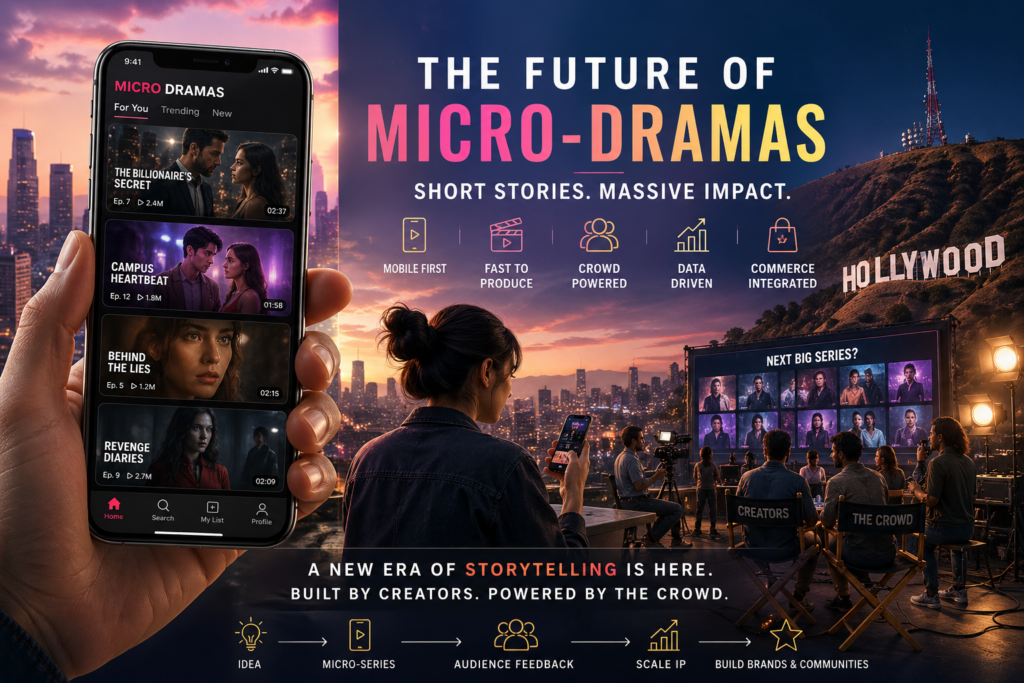
the future of micro dramas 1536 x 1024

The Future of Micro-Dramas: How Short-Form Storytelling Could Rewire Hollywood

The television industry is undergoing a structural shift that feels both inevitable and overdue. It mirrors what happened to music when streaming replaced physical albums and what happened to journalism when distribution migrated to social feeds. At the center of this transformation is the rise of micro dramas, a form of short, serialized storytelling typically ranging from one to ten minutes per episode, designed for mobile consumption and rapid distribution.

At first glance, micro dramas may seem like a simple evolution in format. In reality, they represent something much deeper. They are not just changing how stories are told. They are changing who gets to tell them, how they are financed, and how audiences participate in their success.

At Hollywood Crowd, we see micro series not as a trend, but as the foundation of a new entertainment economy.

The System We Built and Why It Is Breaking

To understand why this shift matters, it is important to look at how television still operates today. The modern ecosystem, dominated by platforms such as Netflix, Disney, Apple, Amazon, Paramount/Warner Bros., and NBCUniversal, is built on scale, capital, and control.

Producing premium content requires massive investment. Individual episodes can cost millions of dollars, in the range of $5M to $15M per episode. Decisions about what gets made are concentrated in the hands of a small number of executives. Development cycles stretch over years, and success is measured not by the performance of a single show, but by its ability to drive subscriptions, ratings and, for streamers, how it retains audiences across an entire platform.

This system has produced global hits and extraordinary storytelling, but it is increasingly misaligned with how audiences behave today. Viewers are overwhelmed with choice, and their attention is fragmented across platforms. Younger audiences are not disengaged from storytelling, but they are consuming it differently, spending more time on TikTok and YouTube than on traditional television.

What appears to be a decline in attention is actually a shift toward formats that deliver faster emotional engagement and more frequent interaction.

A New Storytelling Language

Micro dramas emerge directly from this shift. They combine the narrative discipline of television with the distribution mechanics of social media. Episodes are short, tightly constructed, and engineered to capture attention immediately. Each installment moves quickly, builds tension, and ends with a reason to return.

This is not storytelling that asks for hours of uninterrupted focus. It is storytelling that integrates into daily life, delivered in moments rather than blocks of time. The result is a format that feels native to how people already consume content.

At Hollywood Crowd, we believe this is where storytelling becomes more democratic and more alive. When stories are shorter and faster to produce, more voices can participate. More perspectives can emerge. And audiences are no longer passive viewers. They become active participants in shaping what continues and what disappears.

The Economic Reset

The most important shift is economic. Micro dramas fundamentally change the cost structure of storytelling.

Instead of requiring millions of dollars to produce a single episode, creators can produce entire seasons at a fraction of that cost. This dramatically lowers the barrier to entry and changes the nature of risk. Instead of betting everything on a few projects, creators and companies can test many ideas, learn quickly, and double down on what works.

Speed amplifies this advantage. What once took years can now happen in weeks. A concept can move from idea to audience almost immediately. Feedback is not theoretical. It is real, measurable, and continuous.

This is where Hollywood Crowd’s philosophy becomes central. We believe that the future of entertainment is not built on isolated decision making. It is built on feedback loops between creators and audiences. The crowd is not just watching. The crowd is guiding.

Global Signals of What Is Coming

While the United States is still adapting to this model, other markets have already demonstrated its potential. In China, platforms such as Kuaishou and Douyin have built thriving ecosystems around micro dramas. Entire production pipelines are optimized for vertical storytelling, and some series generate substantial revenue through a combination of advertising and direct payments.

This is not an experiment. It is a working model that shows how quickly storytelling can evolve when the economics and distribution align.

Reimagining Hollywood from the Ground Up

As micro dramas gain traction, they begin to reshape the industry in fundamental ways.

The first change is in who has power. In the traditional system, executives decide what gets made before audiences ever see it. In the emerging system, audiences decide in real time. Performance data becomes the signal that determines what continues and what scales.

At Hollywood Crowd, this idea sits at the core of our model. We believe that culture is not dictated from the top down. It is built from the ground up. The crowd becomes the greenlight.

The second change is in how intellectual property is developed. Instead of investing heavily upfront and hoping for success, creators can launch quickly, test ideas, and expand only what resonates. A micro series that connects with an audience can evolve into something much larger, a long form series, a film, or even a brand.

This is where Hollywood Crowd sees a unique opportunity. By combining storytelling with product development and community engagement, a micro series can become the foundation for an entire ecosystem of content, commerce, and culture.

Talent discovery also changes dramatically. When production costs fall and distribution becomes accessible, creators no longer need permission to begin. They need creativity, consistency, and a connection with their audience. This creates a new pathway into the industry, one that is open, dynamic, and merit driven.

Commerce Becomes Part of the Story

One of the most powerful aspects of micro dramas is their ability to integrate commerce naturally into storytelling. Because the content is produced quickly and evolves based on audience feedback, products and brands can develop alongside the narrative.

At Hollywood Crowd, this is not an afterthought. It is a core principle. We see a future where creators and the crowd collaborate not only on stories, but on the products that emerge from them. Apparel, digital goods, and experiences are not separate from the story. They are extensions of it.

The Constraints and the Opportunity

Micro dramas are not without limitations. Short formats can constrain complex storytelling. Monetization models are still evolving. Platform dependency introduces risk, as creators rely on algorithms that can change without warning.

However, these challenges are not barriers. They are design constraints. And within those constraints lies the opportunity to build new systems that are more flexible, more responsive, and more aligned with audience behavior.

A Hybrid Future

The future of entertainment is unlikely to be one format replacing another. It is more likely to be a convergence.

Micro dramas will serve as the discovery layer, where ideas are tested and audiences are built. Traditional streaming platforms will continue to play a role in scaling successful stories into larger productions. Surrounding both will be communities and commerce layers that deepen engagement and create new revenue streams.

In this model, micro series become the research and development engine of Hollywood.

At Hollywood Crowd, we are building directly into this future. Our platform is designed to connect creators and audiences in a continuous loop of creation, feedback, and growth. We are not just producing content. We are building a system where culture is created together.

The Platform That Does Not Yet Exist

The defining platform for micro dramas has not yet emerged. Just as Netflix reimagined distribution for streaming, the next generation leader in this space will combine elements of a studio, a social platform, and a marketplace.

It will not simply produce shows. It will enable ecosystems.

Hollywood Crowd is built on the belief that this platform should not be controlled by a few. It should be shaped by many.

A New System for Storytelling

Micro dramas are often described as shorter television. That description misses the point. They represent a new economic and creative system for storytelling, one that shifts power from gatekeepers to creators and from passive audiences to active communities.

At Hollywood Crowd, we believe this is the future of entertainment.

Not just watching stories. . . but building them together.

Leave a Comment

Your email address will not be published. Required fields are marked *

Shopping Cart
Scroll to Top